There’s something captivating about a black sand beach. The sea seems a deeper shade of sapphire and the sand sparkles thanks to the high mineral content of volcanic matter.
Black sand beaches are located all over the world, from the sheer-sided caldera of Santorini in Greece to the geothermal hotspot of the Canary Islands, as well as mountainous Hawaii, lush Tahiti, Japan, and several islands in the Caribbean.
Here are some of the most spectacular black sand beaches in the world.
Perivolos Beach, Santorini, Greece
Perivolos Beach in Santorini, Greece
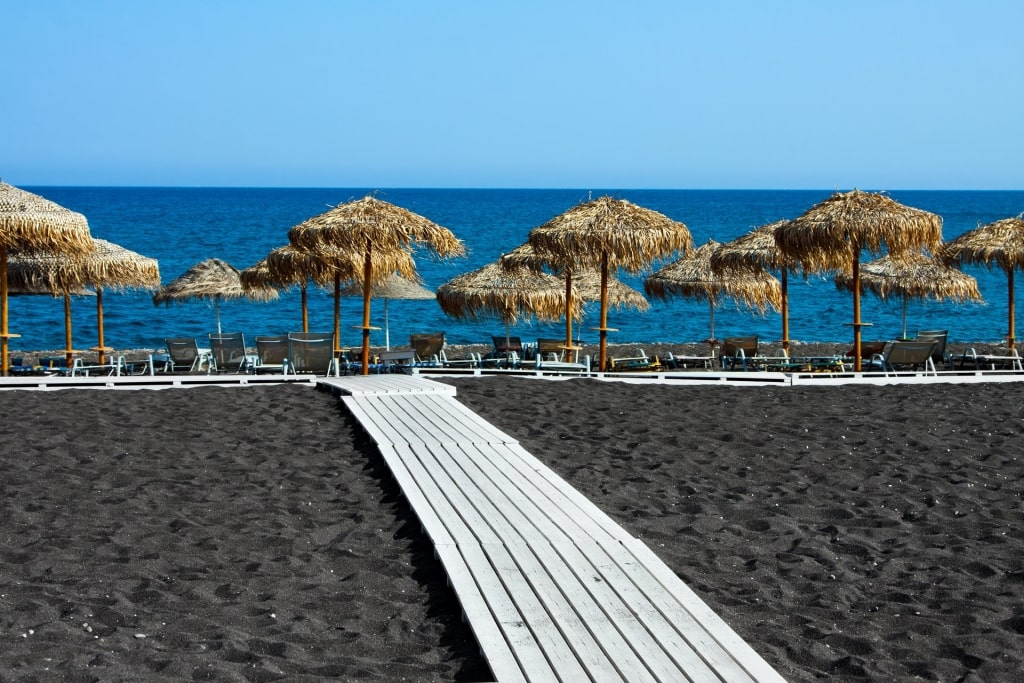
Volcanic Santorini is ringed by sparkling black sand beaches, but Perivolos, in the south of the crescent-shaped island, is the longest. It’s also one of the most organized, with thatched umbrellas, watersports concessions and waterfront tavernas selling fresh seafood for lunch.
The nearest town is Perissa, served by Santorini’s efficient local bus service, and from there, you can stroll the very scenic couple of miles along the seashore to Perivolos.
Taharuu Beach, Papeete, Tahiti
Taharuu Beach in Papeete, Tahiti
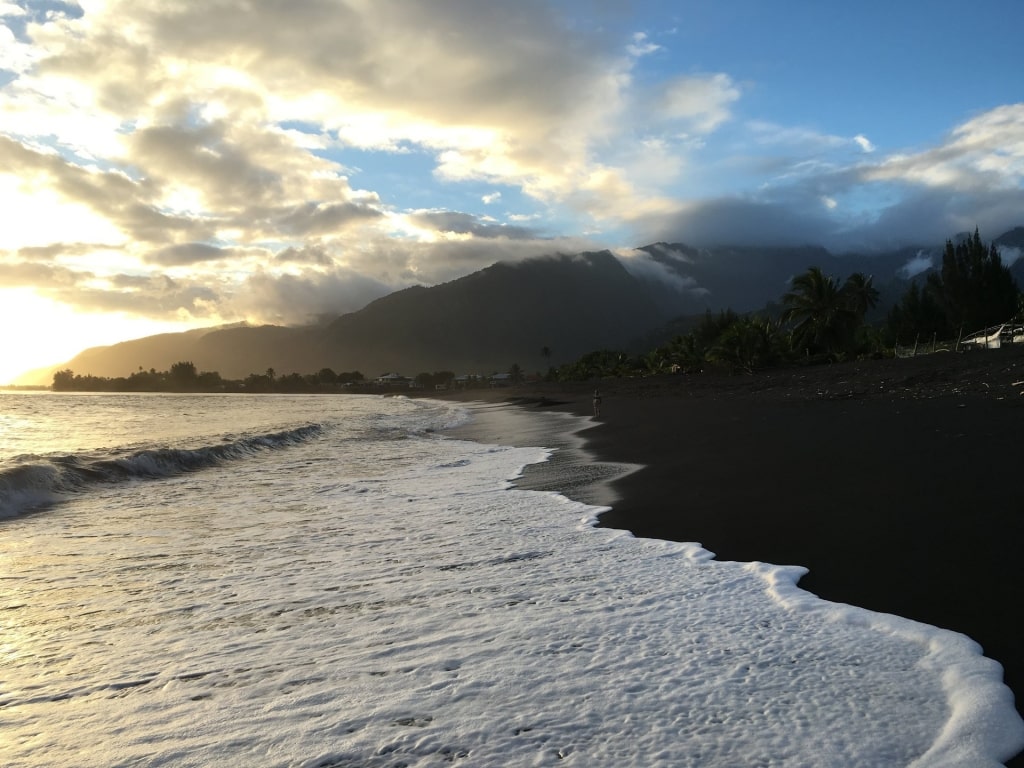
Some 25 miles southeast of Papeete, in Papara, Taharuu Beach is the real thing: a wide sweep of jet black sand, glossy green palms and deep blue sea. Swimming here is safe, although there are decent enough waves for surfers to hone their skills.
You’ll see a lot of locals here, as well as visitors. A small beach shack serves snacks, but you should bring your own water. It’s very easy to lose track of time at Taharuu, splashing in the warm water, taking in the natural beauty and watching the surfers.
Reynisfjara Beach, Iceland
Reynisfjara Beach, Iceland
You certainly won’t be visiting Iceland’s dramatic black sand beaches to swim, but the coastal scenery is jaw-droppingly spectacular. If you’ve already explored Reykjavik and done the Golden Circle, consider a day trip to dazzling Reynisfjara, two hours’ drive from the capital across stark, treeless landscapes of black lava. The journey itself is part of the attraction.
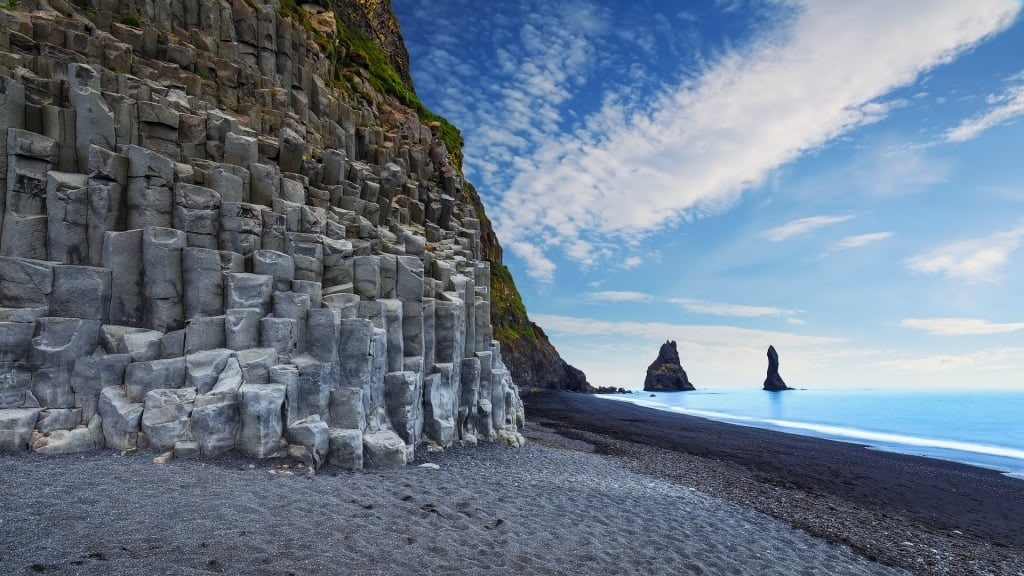
At Reynisfjara, basalt sea stacks pointed like witches’ hats jut out of the sea, believed in local lore to be trolls turned to stone while dragging a ship to shore. The beach itself is a vast expanse of glittering black sand. The whistling wind and the crashing of rollers on the shore create an eerie, otherworldly sound, and you may well have the place to yourself.
Playa Jardin, Tenerife, Canary Islands
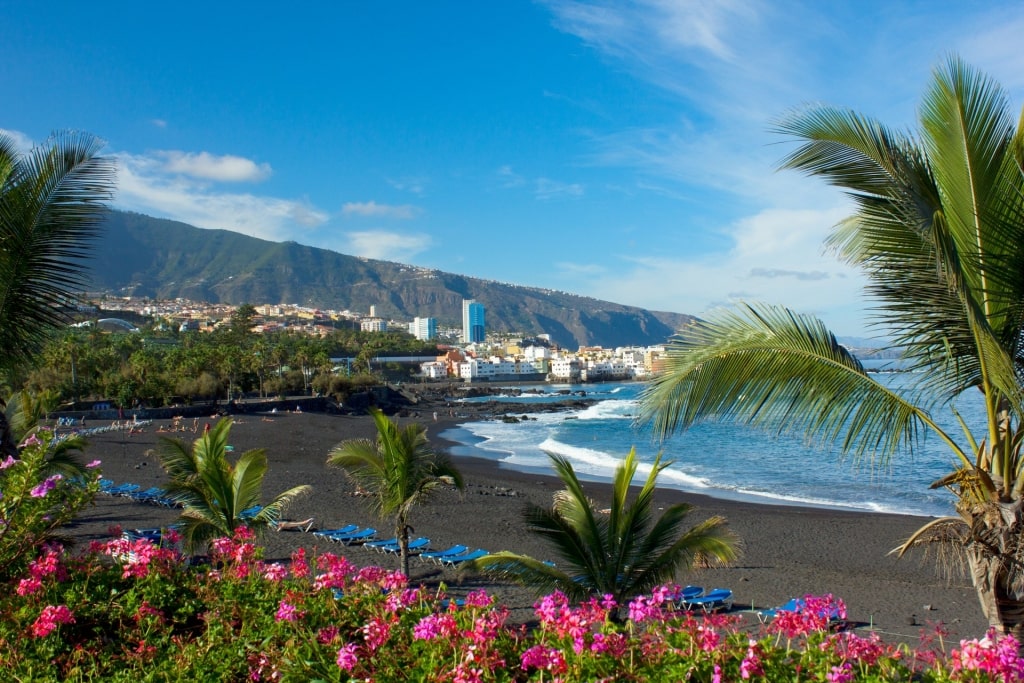
Playa Jardin in Tenerife, Canary Islands
Playa Jardin is part of a stylish complex of urban black sand beaches and gardens in Tenerife designed in the 1990s by legendary Spanish architect César Manrique. The beach is actually artificial, although you wouldn’t know by looking at it; the black sand has been dredged from the seabed.
This Canary Island beach is located in the upscale resort town of Puerto de la Cruz on the island’s west coast. There are three sections, divided by breakwaters to keep the biggest Atlantic rollers at bay, but leaving enough surf to attract anybody wanting to test the waves.
Kids’ playgrounds, cafés, subtropical gardens and the looming peak of mighty Teide, Spain’s highest mountain, create a pleasant setting. If Teide is wearing its snowy cap, the scenery is all the more dramatic.
Punalu’u Beach, Hawaii
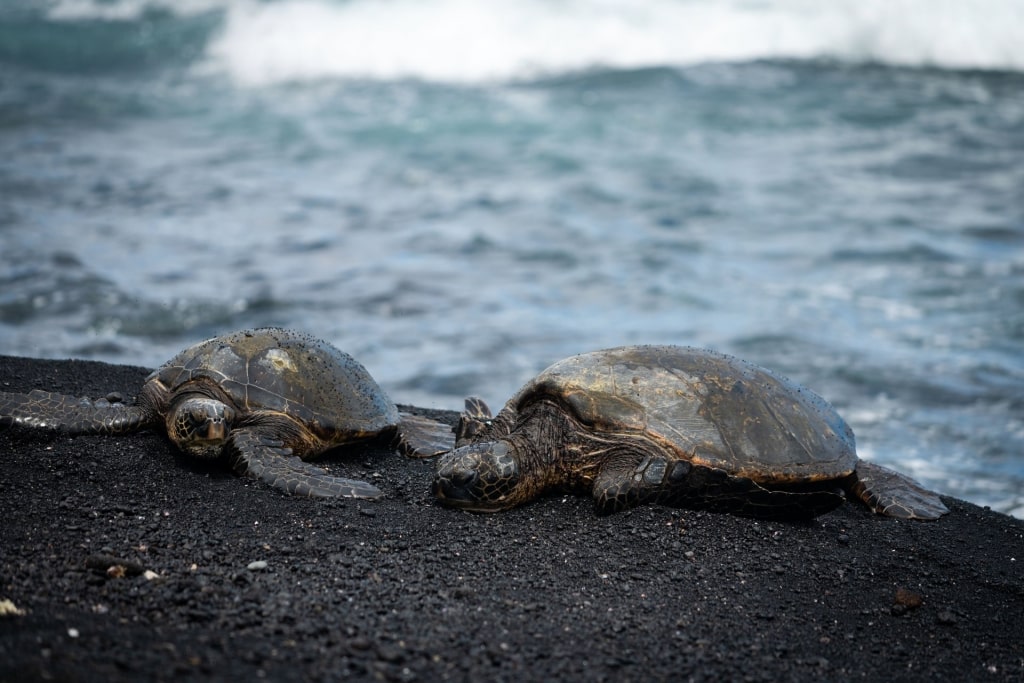
Punalu’u Beach, Hawaii
Fringing the southeastern coast of the Big Island of Hawaii, Punalu’u is one of Hawaii’s most striking black sand beaches. Tall coconut palms arch over jet black sand, where protected green sea turtles nest. This is more of a beach for simply taking in the view and enjoying a picnic than for swimming, as the currents can be strong, but it’s certainly extraordinary to look at.
If you do venture into the water, be prepared for a strange sensation. Freshwater springs bubble up under the seafloor here and the cold water rises to the surface, so you could find yourself swimming in water that is alternately warm and bracingly cold.
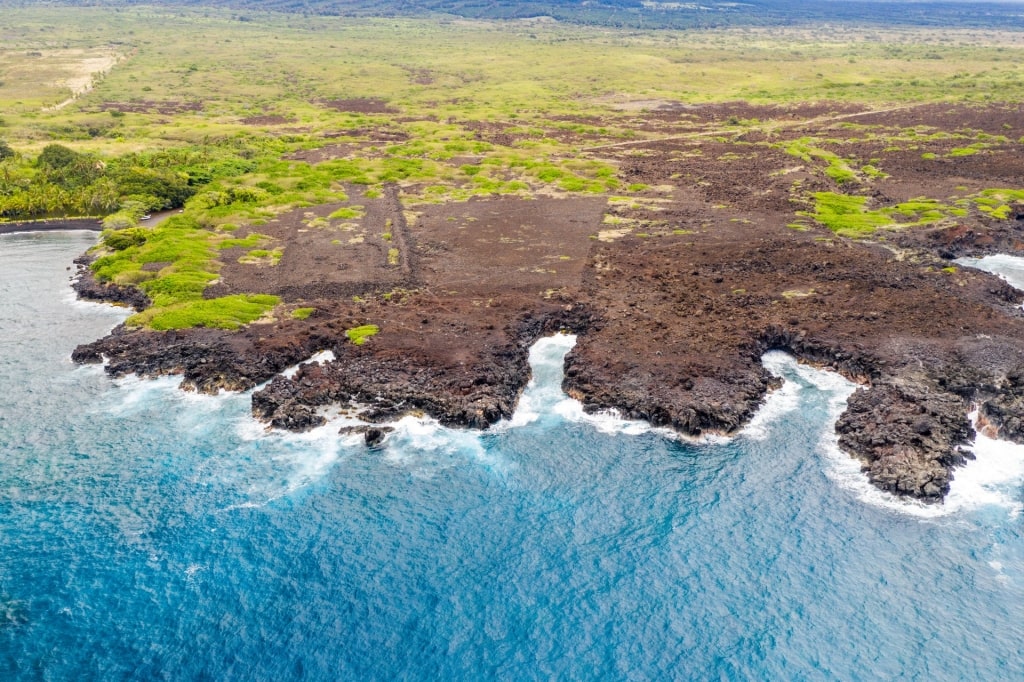
Punalu’u Beach, Hawaii
Like all the black sand beaches on Hawaii, Punalu’u is protected and you’re not allowed to take any sand. Black sand beaches are often fragile, in geological terms. Because they’re created by volcanic eruptions, which may only occur once every few centuries, there’s little to replenish the sand if a storm sweeps it away, unlike, say, coral sand beaches, which are restocked by nature on a continual basis.
Mero Beach, Roseau, Dominica
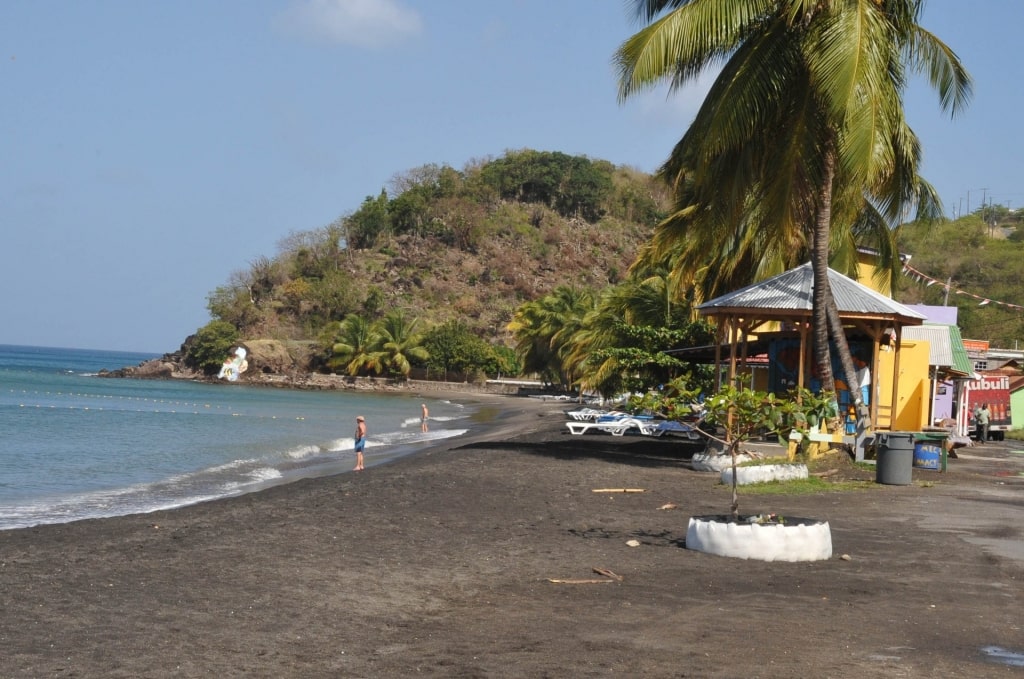
Mero Beach in Roseau, Dominica Photo by Jerrye & Roy Klotz, MD on Wikimedia Commons, licensed under CC BY-SA 3.0
Volcanic Dominica is wild and untamed by Caribbean standards, with mountainous, jungly scenery and sparkling beaches, some in shades of silvery gray. Mero, just half an hour from Roseau, the island’s capital, is a favorite with locals who descend on the beach on weekends for barbecues and swimming in the warm, shallow water.
Generally, though, this is a peaceful spot in Dominica, with a few beach bars and restaurants nearby to make a day of it with a laid-back, toes-in-the-sand lunch.
Senggigi Beach, Lombok, Indonesia
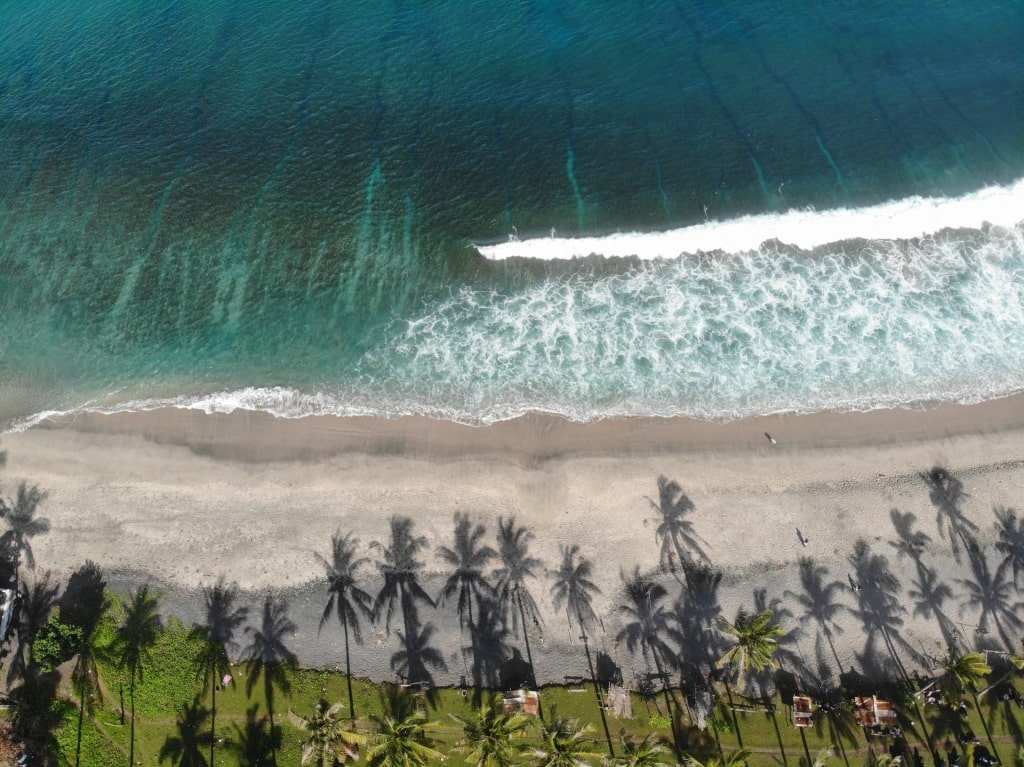
Senggigi Beach in Lombok, Indonesia
Hugging the mountainous northwest coast of Lombok, Senggigi is a popular strip of black and gold sand, a product of the many eruptions of Mount Rinjani which looms in the distance.
One of the best beaches in Asia, Senggigi is lined with hotels and restaurants, with more places to explore set just inland. Clear water means there’s good snorkeling here, while there’s no shortage of activities, from stand-up paddleboarding to sea kayaking.
Miho-no-Matsubara, Shizuoka City, Japan
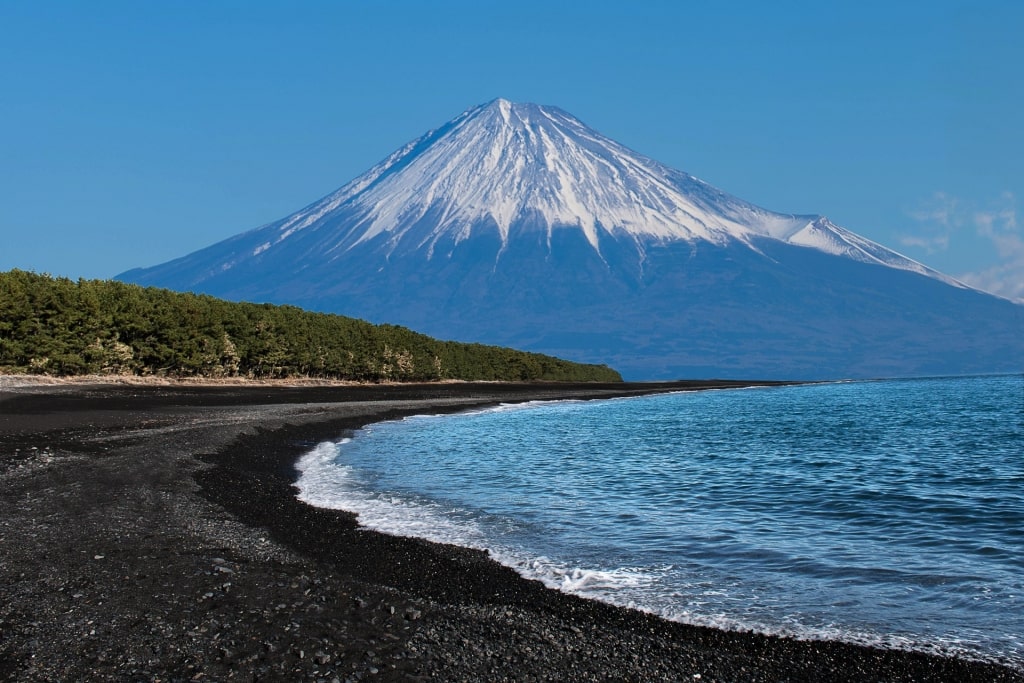
Miho-no-Matsubara in Shizuoka City, Japan
Miho-no-Matsubara is a mesmerizing sight. A dense pine forest of more than 54,000 trees spills onto a beach of jet black sand, four miles long, the conical, snow-capped dome of Mount Fuji towering in the background. Little wonder that this beautiful and unusual beach has inspired writers and poets.
The Miho peninsula, an easy train ride from Tokyo, is popular in summer for windsurfing, diving, fishing and swimming. You can also rent a bicycle and cycle around the peninsula, or stroll through the scented shade of the pine woods.
El Golfo, Lanzarote, Canary Islands
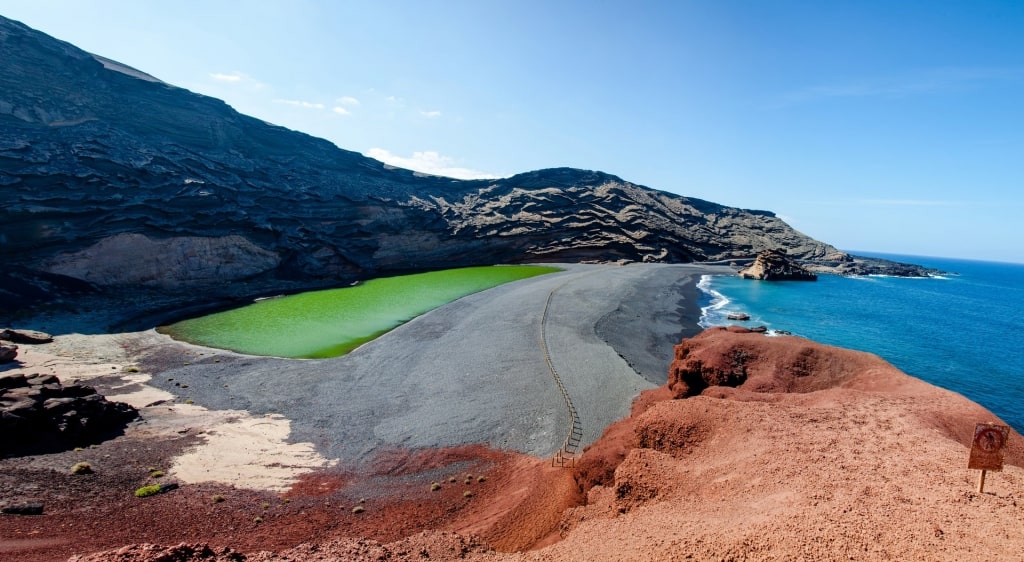
El Golfo in Lanzarote, Canary Islands
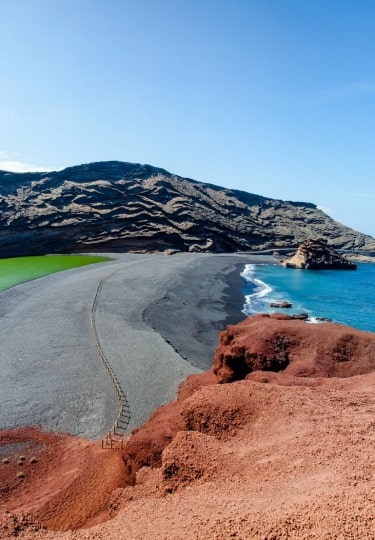
If anywhere sums up the sheer otherworldliness of volcanic Lanzarote, it’s this jet black beach, hemmed in by the eroded semicircle of an ancient volcano.
At the center of what was once the caldera, separated from the pounding waves by low black dunes, there’s an emerald-green lagoon, Lago Verde. The lagoon gets its bright green color from a type of phytoplankton that thrives on seawater that’s filtered through the volcanic material.
Neither the lagoon nor the wild Atlantic rollers are exactly inviting for swimming, but there’s no question that El Golfo is one of the most photogenic spots on this extraordinary island. Numerous movies and commercials have been shot here, and visiting is one of the best things to do in Lanzarote.
There are no facilities, which is all part of the setting’s charm, but after admiring the black-and-red layered cliffs, the lagoon and the sparkling beach, head for the village of El Golfo itself, where you’ll find plenty of decent seafood restaurants.
Kamari Beach, Santorini, Greece
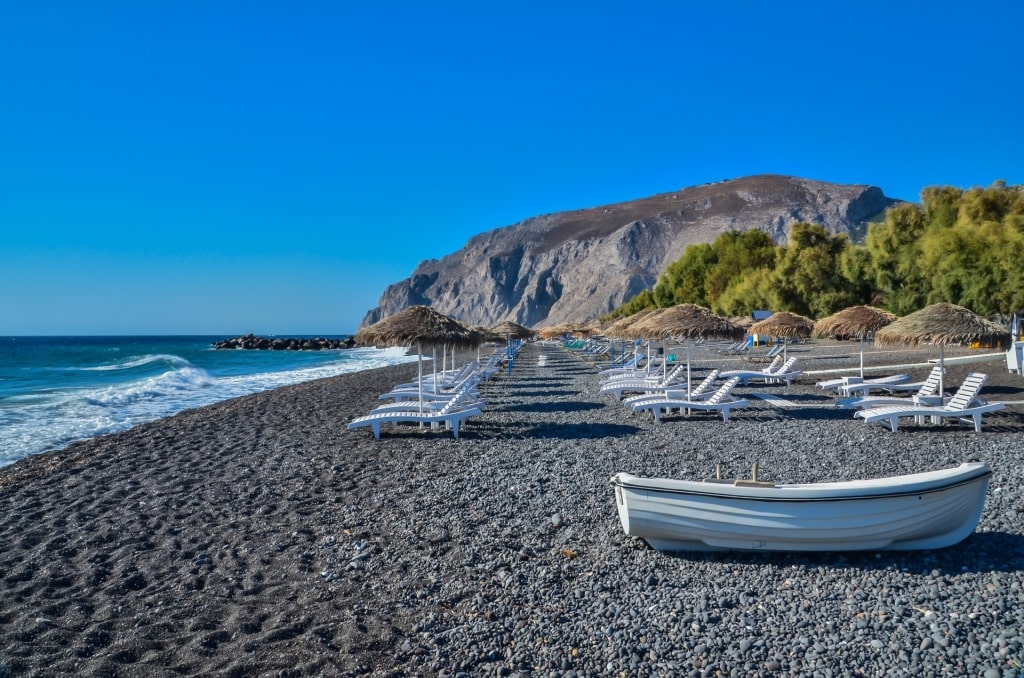
Kamari Beach in Santorini, Greece
Stretching along the eastern shore of Santorini, Kamari Beach is composed of black, pebbly sand; like all the black sand beaches on the island, much of this material would have originated in the cataclysmic eruption that changed the shape of the island in the 17th century B.C.
One of the best beaches in Santorini, its stark beauty is overlooked by the hulking Mesa Vouno mountain. It’s lined by bars, shops and tavernas in the characteristic Cycladean style of brilliant white with splashes of sky blue.
Kamari today is a family spot by day and something of a party place in the evenings, where DJs spin tunes as the sun begins to set. If the heat becomes too intense while you’re sunbathing, take a stroll into the shaded back alleys of the resort where you can take refuge in cool, quirky boutiques or relax in the shade of a bar with an ice-cold Mythos beer.a
Anse Couleuvre, Saint-Pierre, Martinique
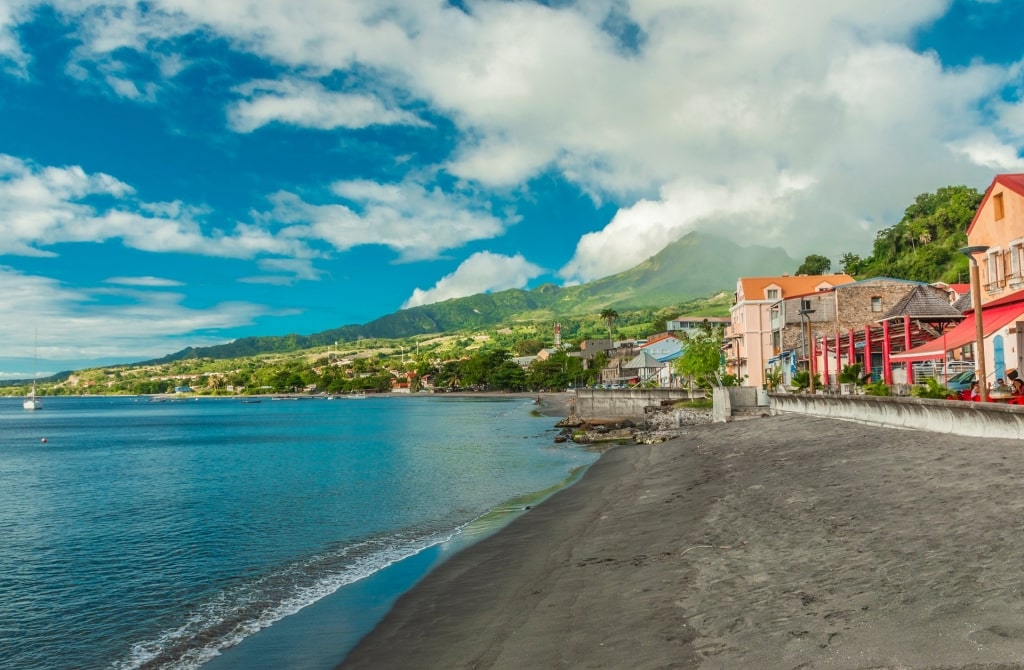
Anse Couleuvre in Saint-Pierre, Martinique
Martinique is dominated by the 4,503-foot peak of Mont Pelée, an active volcano. As such, many of the island’s beaches are composed of black sand. The town of Saint-Pierre de la Martinique has an uneasy relationship with the mountain, having been almost totally destroyed by a massive eruption in 1902.
The pretty little town itself, now rebuilt, is fronted by a black sand beach, but there’s an even better treat just to the north. Here, Anse Couleuvre has to be one of the most beautiful stretches of sand on the island.
Dense vegetation plunges to the water’s edge, the beach itself a little half-moon of sand shaded by coconut palms. Just over an hour from Fort-de-France, it’s not easy to find. The last section of the journey is done on foot once the road runs out, but the reward is a pristine stretch of often deserted sand.
Read: Best Beaches in the Caribbean
Karekare Beach, Auckland, New Zealand
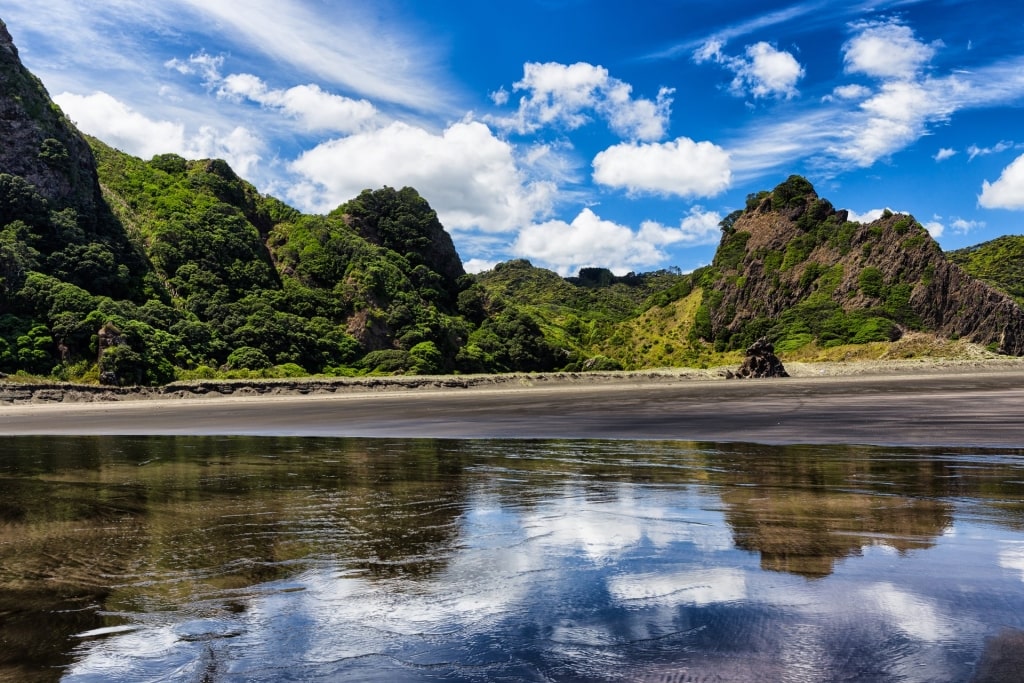
Karekare Beach in Auckland, New Zealand
The glittering black sands of Karekare Beach are only a 50-minute drive from Auckland, with the added bonus of a tumbling waterfall a 15-minute stroll from the beach. You can cool off in the rock pool at the base of the falls after the walk, or relax in the shade there.
This beach is a wide expanse of sparkling black sand, pounded by tumbling waves and backed by black cliffs and low-lying dunes, on which you’ll see locals sand surfing. Bring a picnic for your visit here; this is a wild, remote spot without facilities.
Read: Best Beaches in Auckland
Black Sands Beach, Sausalito, California
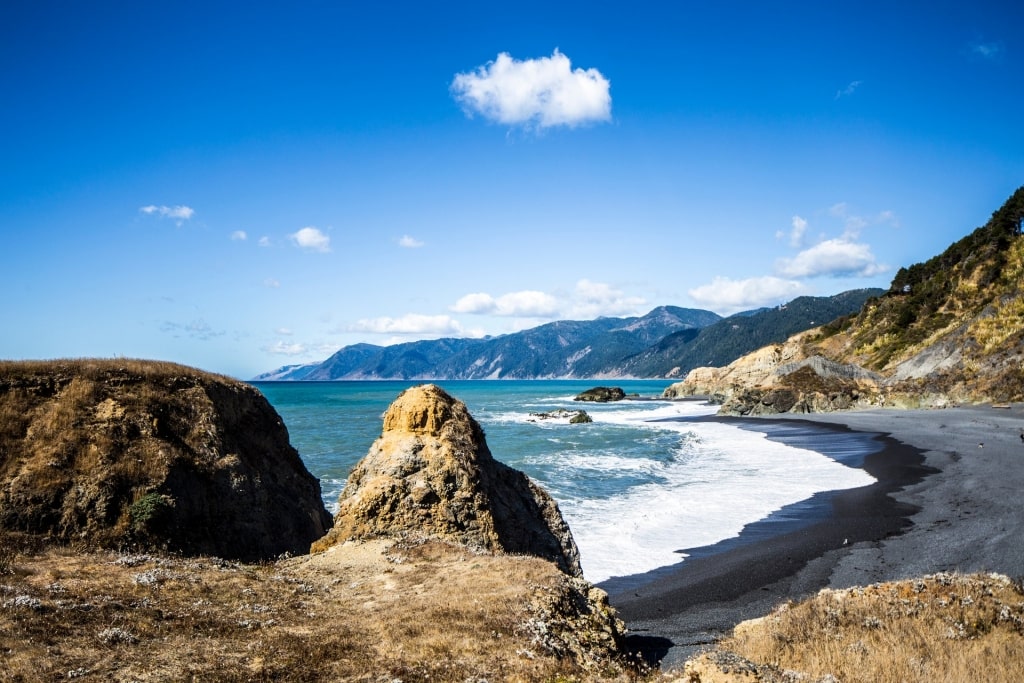
Black Sands Beach in Sausalito, California
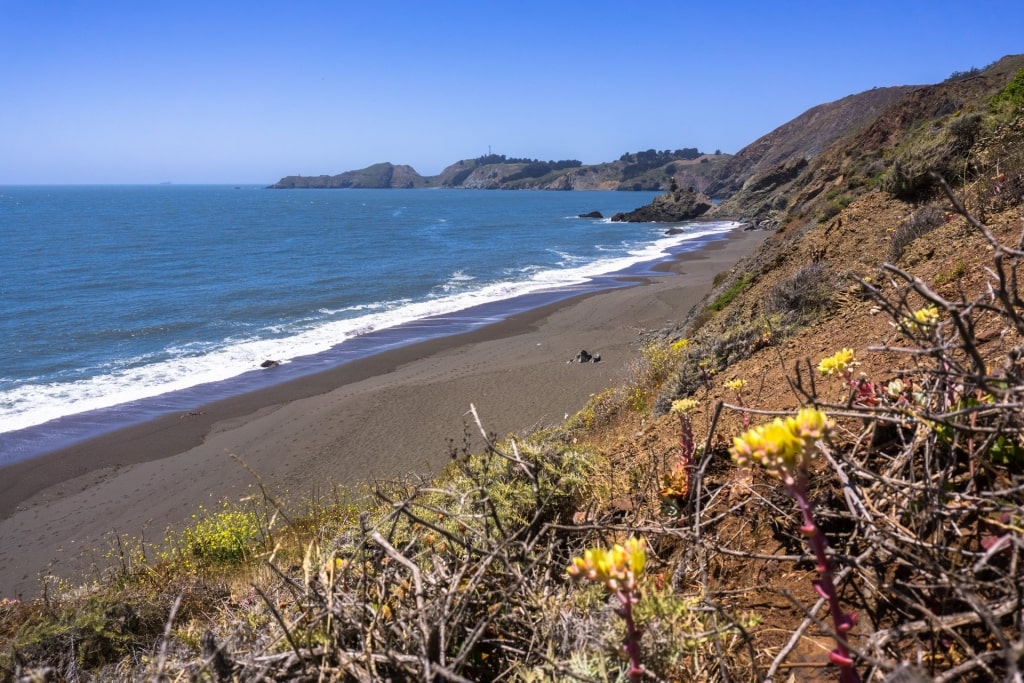
Across the Golden Gate Bridge, beneath the Marin Headlands, you’ll find one of the only black sand beaches in the continental U.S. Black Sands Beach is a narrow strip of sand at the base of sheer cliffs, which is even more dramatic-looking and narrower at high tide, so do check the tide timetables before you make the journey.
You’re here for the novelty rather than the swimming, as strong currents and pounding surf make swimming dangerous. Be aware, too, that one end of the beach is clothing optional.
Lovina Beach, Bali, Indonesia
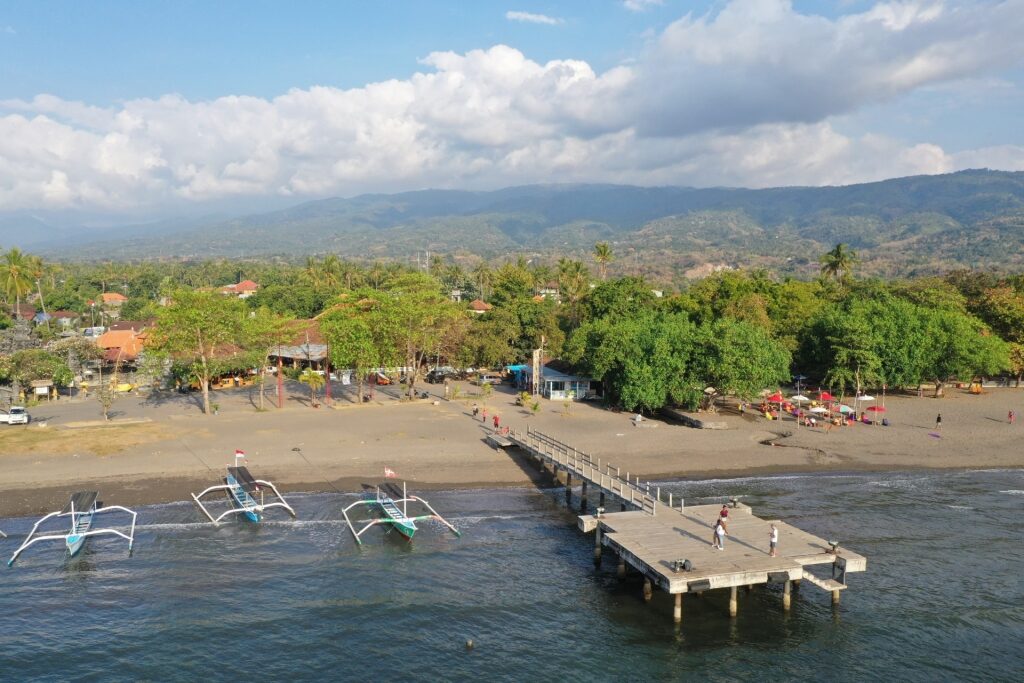
Lovina Beach in Bali, Indonesia
Lovina Beach gets its distinctive color from black volcanic sand, formed from eroded volcanic rocks. As you stroll along the beach, situated along Bali’s northern coast, you can feel the silky smooth sand between your toes.
North Bali is less developed than the south, so the mood in this peaceful bay is laid-back and fairly introspective. Lovina’s sand also features glittery mica crystals, which, in the right light, can cause the Balinese beach to sparkle.
You’ll come across Balinese boatmen here with small wooden outriggers, which they use for dolphin-watching tours. Hopping on a boat to look for some marine life and to check out the shore from the water is a great way to extend your time along this beautiful black-sand beach.
Dyrhólaey Beach, Iceland
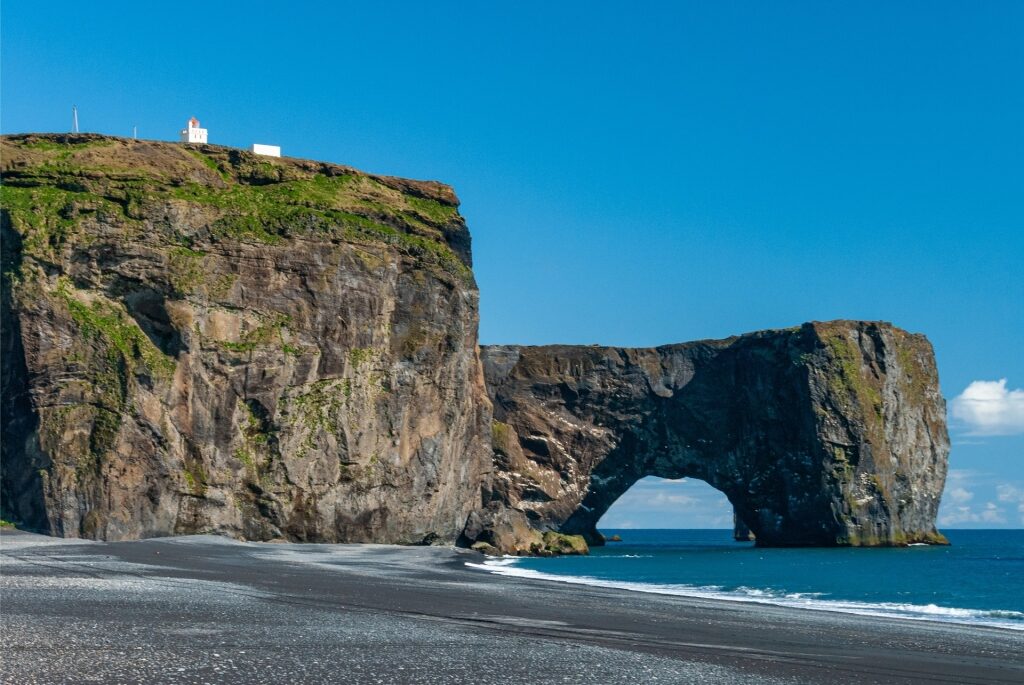
Dyrhólaey Beach, Iceland
For a stark, black sand beach that contrasts with the green of the warmer months and the snowy white of winter, visit Dyrhólaey, where a narrow ribbon of jet-black sand faces the North Atlantic.
Dyrhólaey features mammoth basalt cliffs, powerful ocean spray, and black sand produced by Iceland’s volcanoes, which have been erupting, on and off, for millions of years.
Weather and water have ground the basalt here into glossy black grains that can shimmer in the bright sun, especially when wet. The border between surf and shore at Dyrhólaey is distinctly defined—a surrealist dreamscape of blue water, white surf, and coal-like sand.
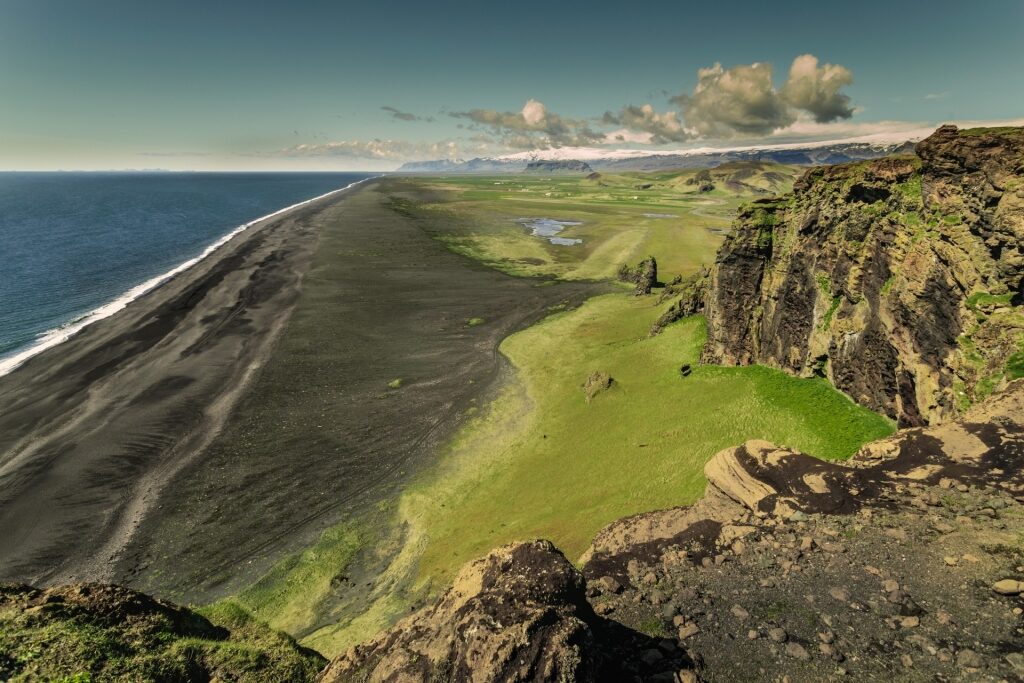
Dyrhólaey Beach, Iceland
Locals aren’t shy about telling visitors to stay clear of the water. Sneaker waves, which rush toward the shore at unexpected intervals, have enormous force.
During the summer, you can also see puffins nesting in the cliffs above the Icelandic beach, which is a sight to behold. And, as always, be respectful of the island’s fragile vegetation and avoid trampling the ground.
Ibusuki Beach, Japan
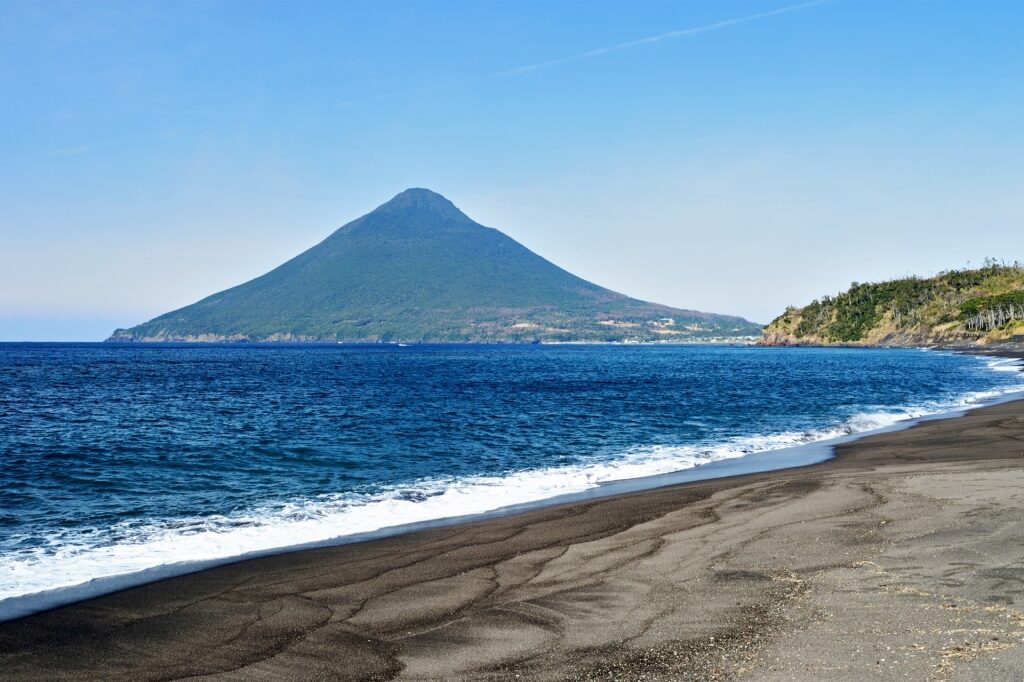
Ibusuki Beach, Japan
If you want to be buried in velvety black sand, Ibusuki Beach is the place to go. Ibusuki, in Kagoshima, is notable among beaches with black sand for its color, of course, but also for the volcanic hot springs beneath the sand that naturally heat the Japanese beach.
Sand bathing staff here will hand you a light cotton kimono-esque yukata; once you’re ready, attendants will shovel black sand over your body. Within minutes of being “buried,” you will feel a wash of heat radiating through your muscles as you experience a cleansing sweat.
The tradition of sand baths in Ibusuki, known as sunamushi, is centuries old; visitors tend to follow a ritual pattern: sand bath, rinse, mineral bath. While you bathe, you can enjoy the beauty of Kagoshima Bay and the massive Mount Kaimon volcano in the distance.
Playa de Benijo, Tenerife, Canary Islands
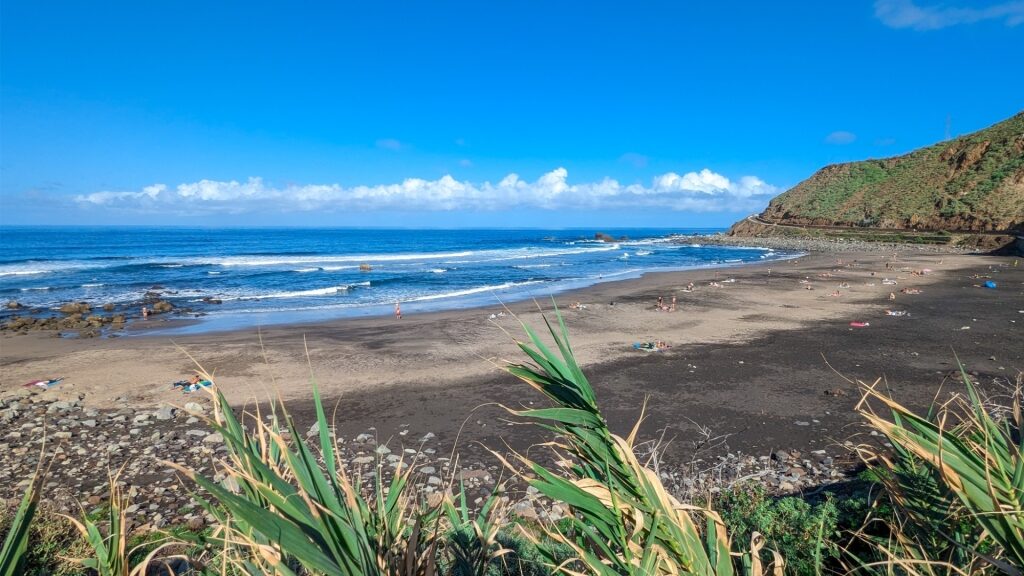
Playa de Benijo in Tenerife, Canary Islands
The winding road to Benijo runs through the lush Anaga Mountains before suddenly opening out onto a vertiginous scene of surf, craggy sea stacks, and dark black sand.
The sand along this spectacular shoreline owes its color to Tenerife’s volcanic past. Centuries of slow erosion and grinding by the Atlantic tides have broken basalt into these fine, dark grains.
The currents are strong at this Tenerife beach, with waves rolling across Benijo that make for dramatic photographs and reliable swells for surfers to ride.
Local guachinches serve fresh fish, with simple dishes like potatoes, papas arrugadas, and mojo sauces to feast on as you take in the intense beauty of this black-sand beach and let it fill your soul.
Praia do Fogo, São Miguel, Azores
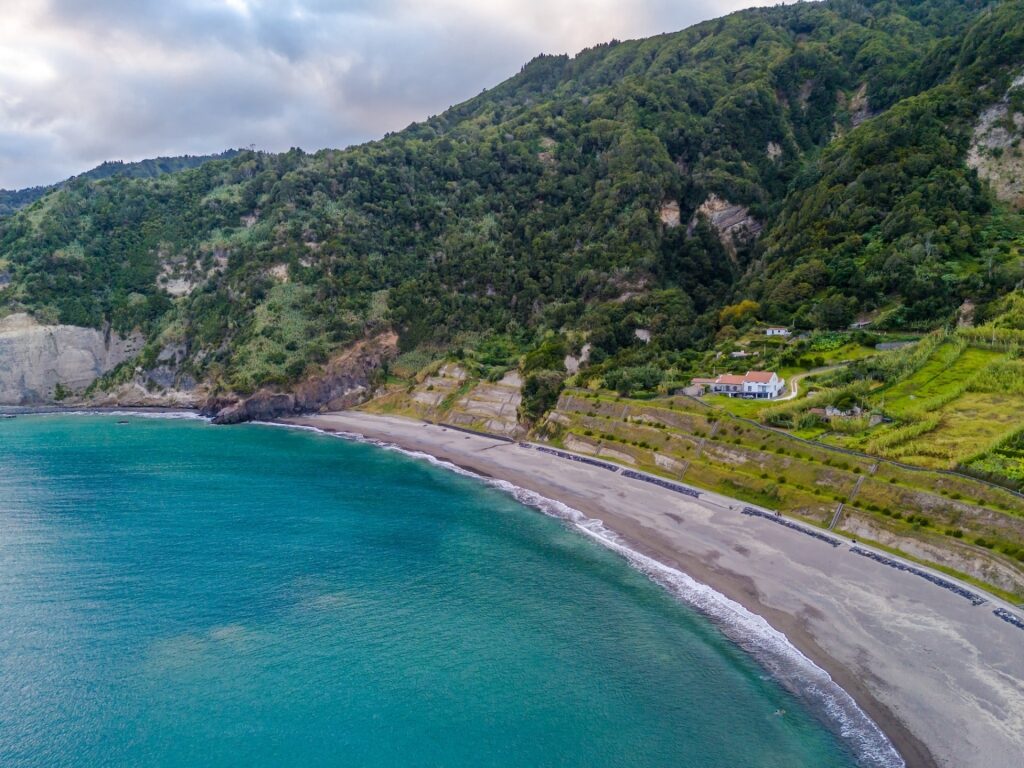
Praia do Fogo in São Miguel, Azores
Praia do Fogo, on the island of São Miguel near the fishing village of Ribeira Quente, will greet you with black sand that hints at the mighty volcanic power at work beneath the island’s surface. The locals also refer to this beach as Praia da Ribeira Quente.
The Azores straddle the Mid-Atlantic Ridge, and geothermal energy here is hard at work, creating hot springs and fumarole stream vents. You might even feel the heat from underground vents warming the sand at different spots along the shore.
Steam from under the ground can rise through fissures near the beach, giving Praia do Fogo, which butts up against steep green hills, its volcanic character. Locals swim here year-round because of the geothermal activity that heats pockets of sand and water near the shore.
Teixidelo Beach, Galicia, Spain
If you ever find yourself in northern Spain, carve out some time to swing by one of Galicia’s most spectacular coastal geographical areas: Teixidelo Beach, which is one of the most unique black sand beaches in the world.
Teixidelo, about a 90-minute drive from A Coruña, is a gorgeous stretch of coastline that rewards you with its towering cliffs, steep, expansive topography, and its otherworldly appearance.
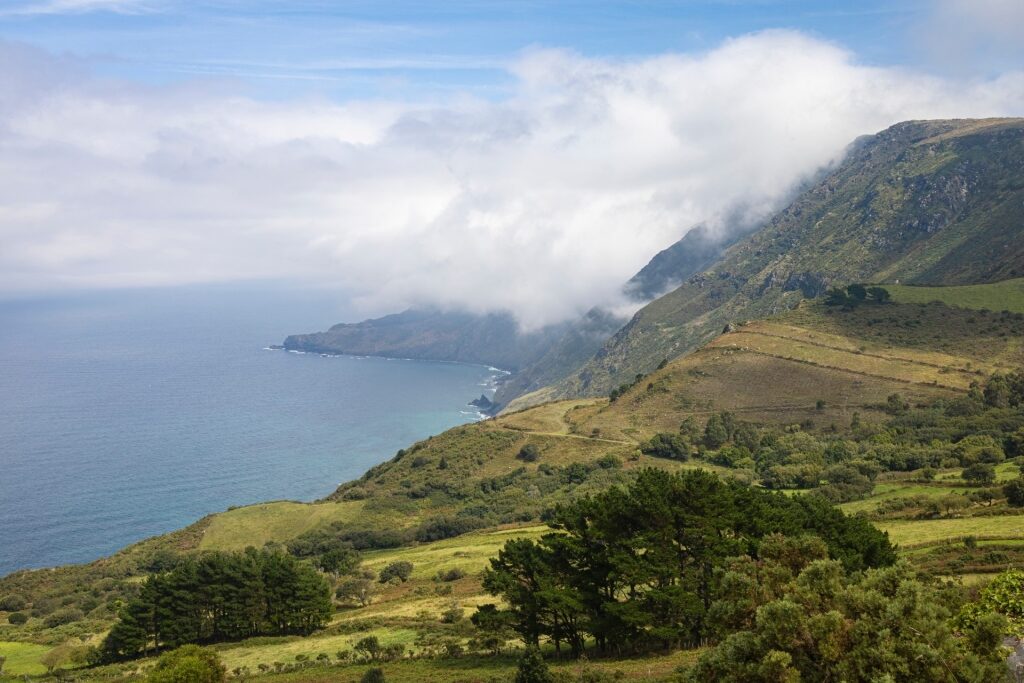
Teixidelo Viewpoint in Galicia, Spain
As you descend from the cliffside trails, you will end up walking along a rare black sand beach of non-volcanic origin. The sand on Teixidelo, rich with dark grains of ultramafic and igneous rock, owes its origin to erosion rather than volcanic activity.
When you stand on this remarkable shoreline, you will be enveloped by the power of nature, strong Atlantic winds, and the raw beauty that make this part of Galicia so unforgettable.
Piha Beach, New Zealand
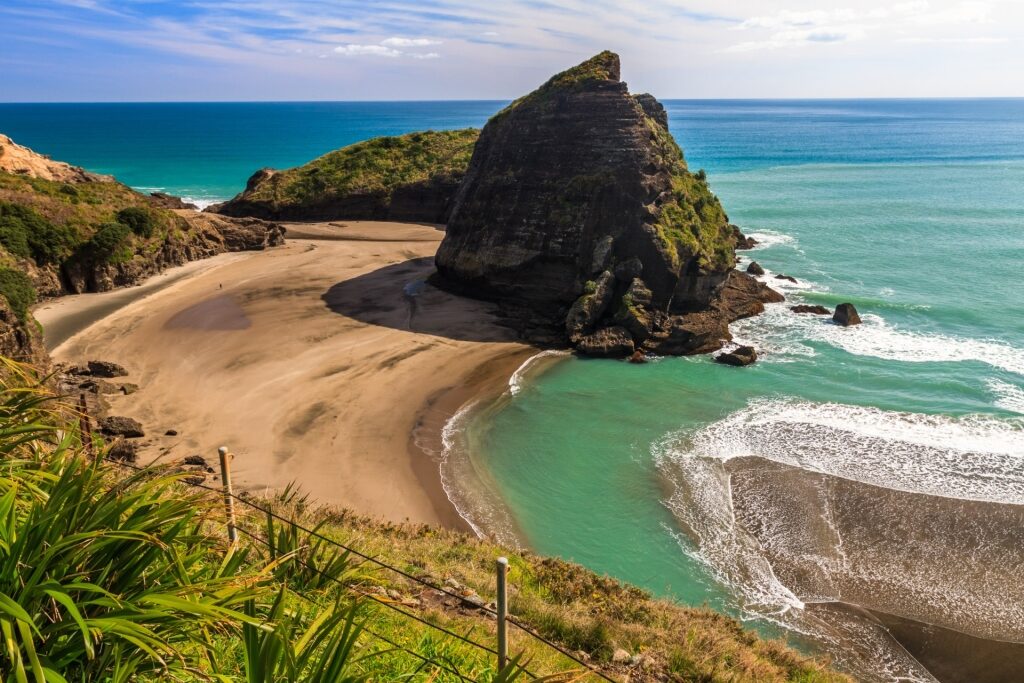
Piha Beach, New Zealand
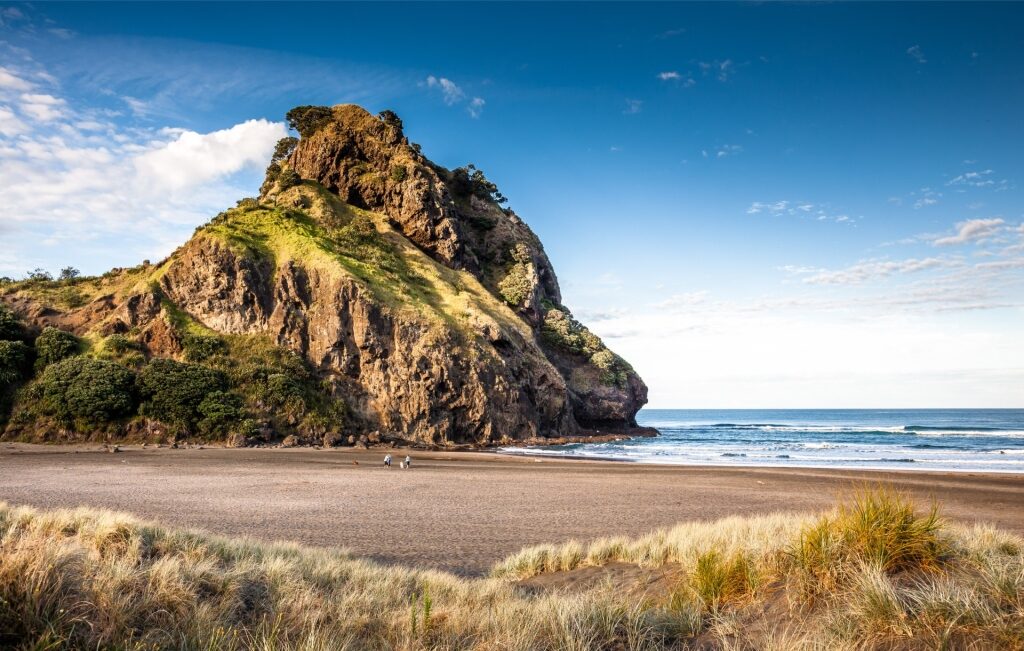
Piha is another Kiwi black-sand beach that features the deep rumble of waves rolling in from the Tasman Sea, with dark iron sands sourced, long ago, from the volcanoes of the Waitākere Ranges and further afield.
Piha is also one of New Zealand’s most renowned surf beaches; the riptides here are strong enough that Surf Life Saving New Zealand has regular safety campaigns encouraging swimmers to keep between the red-and-yellow flags.
You can scramble up the lower lookout on Lion Rock, also known as Te Piha, to take in some awe-inspiring views of the coastline, cliffs, and bluffs pressed against the black shoreline.
Later on, dine with locals at cafés near the beach serving paper-wrapped fish and chips. Piha is one of New Zealand’s best beaches, where poets, surfers, and photographers find inspiration.
Puerto Egas, Santiago Island, Galápagos
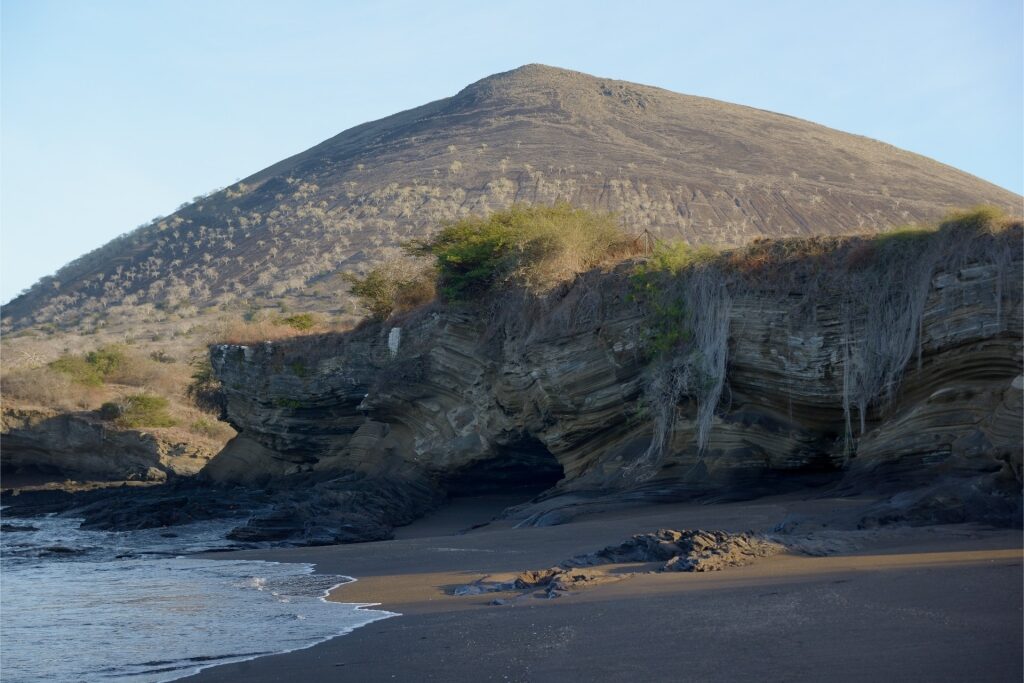
Puerto Egas in Santiago Island, Galápagos
A visit to Puerto Egas and its black-sand beach will connect you with Charles Darwin, helping you understand why he spent so much time on Santiago Island.
The area is filled with eroded volcanic tuff. Puerto Egas is a small cove, bordered by lava formations that create natural platforms where Galápagos fur seals bask in the afternoon sun. Marine iguanas are abundant, too.
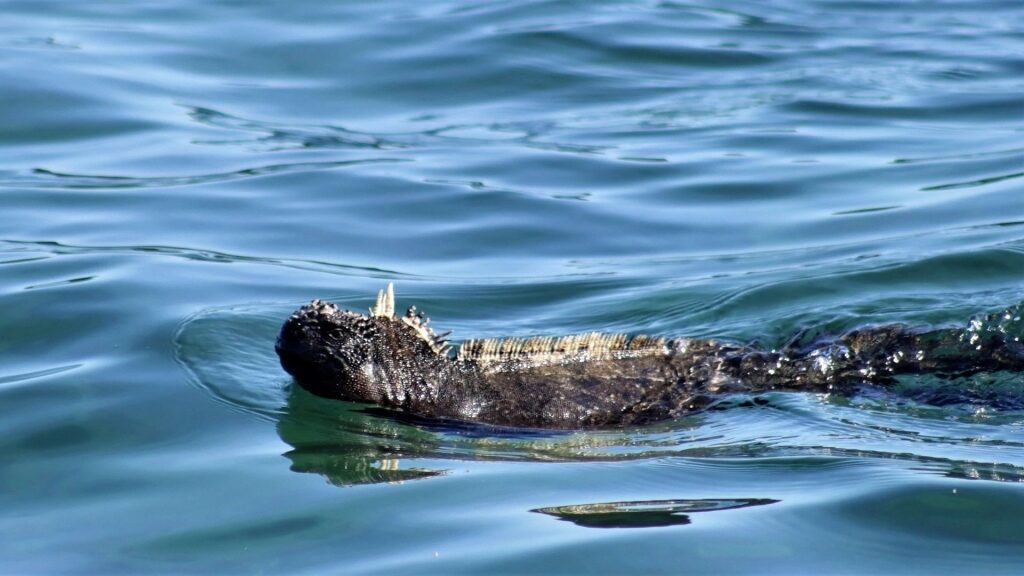
Marine iguana
Snorkeling in the Galapagos is also great fun—you can slide into the clear water and watch sea turtles swimming through the lava arches, then glide through the water with sea lions and occasionally fur seals.
Back on land, you can follow the trail to the “fur seal grottoes,” which will lead you to lava platforms with tidal pools that are great for spotting seals and small marine creatures.
Perissa Beach, Santorini, Greece
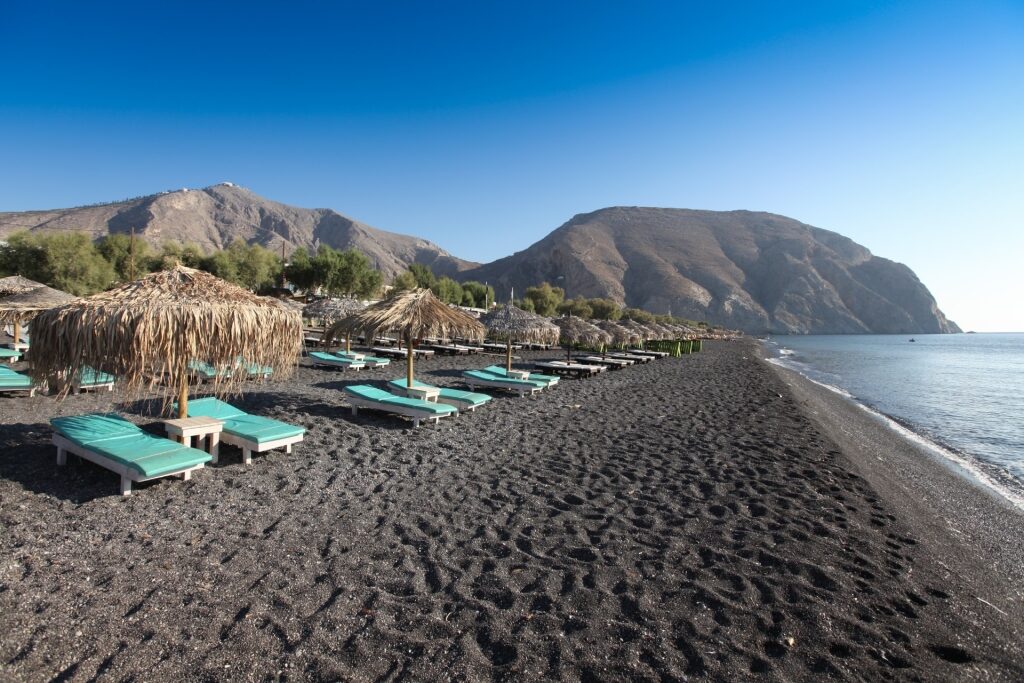
Perissa Beach in Santorini, Greece
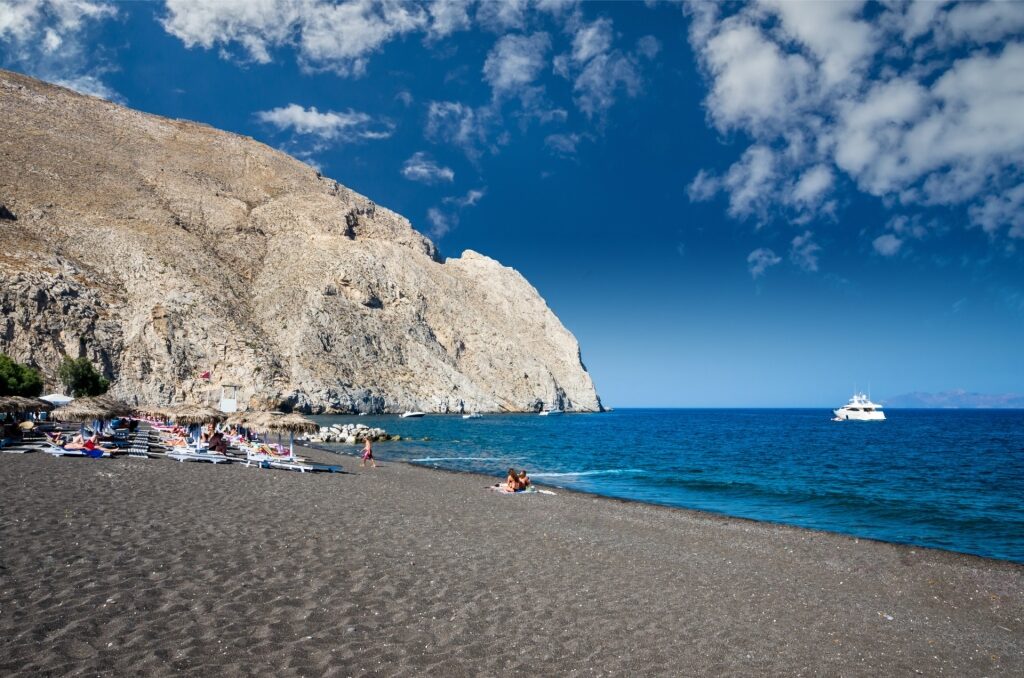
Perissa greets you with a sweeping stretch of black volcanic sand that feels coarse and warm beneath your feet. The ash and basalt that color the grains came from the same eruption that radically altered Santorini more than 3,000 years ago.
You can sense the island’s history in these dark grains and up on Mesa Vouno, the imposing mountain that overlooks this stark-looking Greek beach, pressed up against the Aegean Sea.
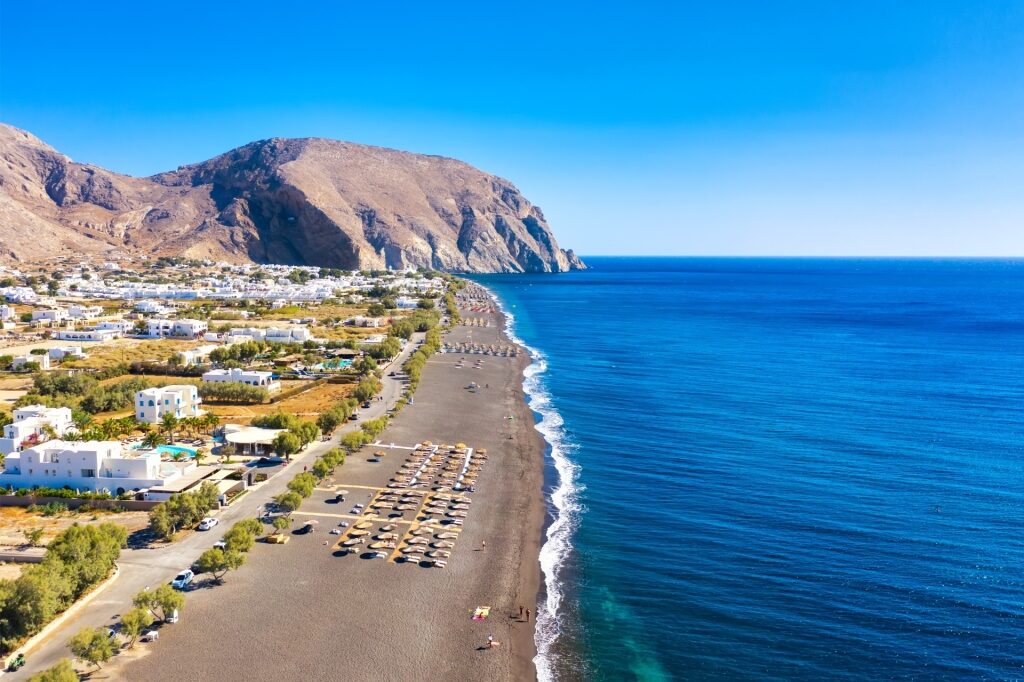
Perissa Beach in Santorini, Greece
The water is refreshingly clear, but it also drops off fairly fast due to volcanic topography. So, ease yourself in gradually.
After a swim or lying on a beachside lounger, you can meander along the promenade of cafés nearby serving fresh seafood, Santorini’s signature fava purée, and chilled glasses of Assyrtiko wine.
What Causes Black Sand Beaches to Form
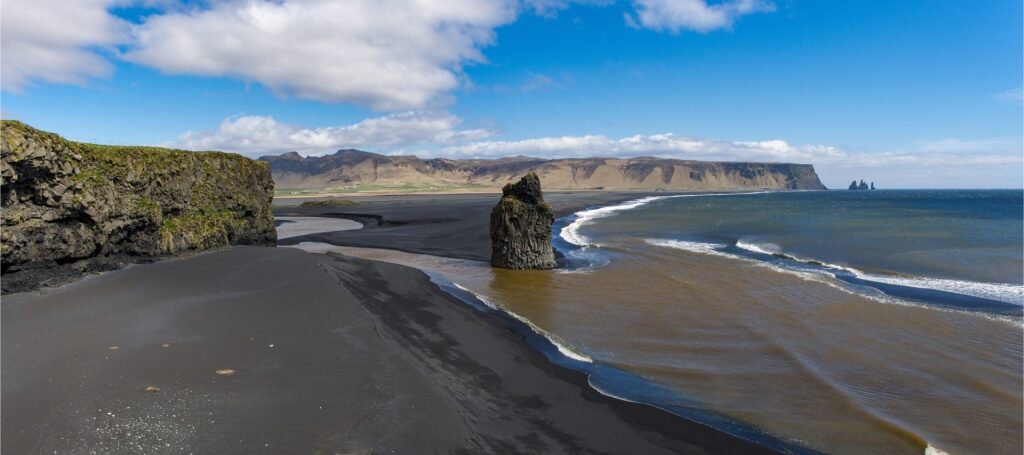
Reynisfjara Beach, Iceland
Stroll barefoot along one of the world’s most beautiful black sand beaches and feel the grains underfoot that often look like pulverized basalt. When the sun is blazing, however, take care, as those same grains might sizzle your toes; black sand easily absorbs and holds the sun’s heat.
The most common reason for the formation of beaches with black sand is volcanic activity. Lava flows into water and cools quickly, getting milled and thrashed by wave action and weathered into dark, sand-sized fragments.
Finely ground basalt, andesite, volcanic glass, magnetite, ilmenite, pyroxenes, and other dark volcanic rocks can go into forming the dramatic black beaches you see around the planet.
Piha Beach, New Zealand
A second reason for black sand beaches is a high concentration of heavy minerals. Wave action and currents sort sediments by weight and drop the densest grains, like magnetite, ilmenite, and other iron-rich minerals, along the shoreline.
This results in dark sand beaches even where there hasn’t been a recent lava flow. Puerto Rico and New Zealand both have beaches that fit this mold. Geologists call these “placer” deposits.
Interestingly enough, the black sands that come from “placer” deposits are often not the most common type of sand in a particular deposit, but due to their dark color, they can dominate a beach’s appearance.
Volcanic glass
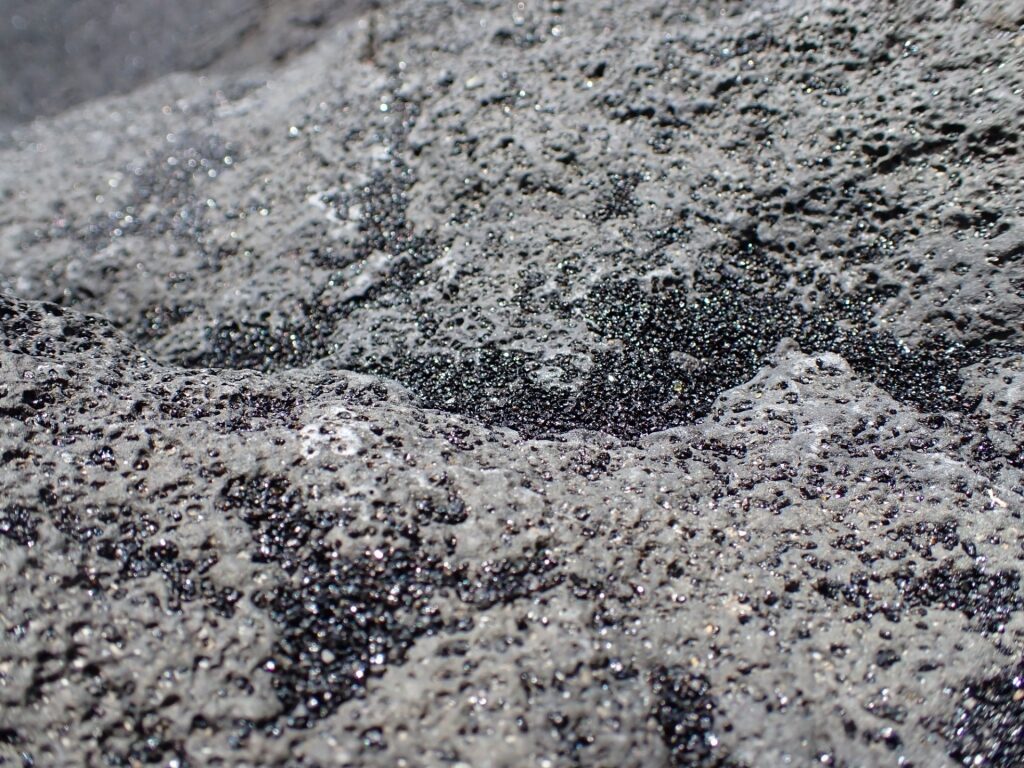
Volcanic glass, known as obsidian, and weathered basalt pebbles can also form black sand beaches, with grains that often look shiny and glassy.
Storms and currents can sift through and rapidly change a black sand beach’s appearance over time, causing it to lighten in hue by burying or redistributing the darker grains, which means, in some cases, the black sand might only be fleeting or transitory in nature.
FAQs
Are black sand beaches safe for swimming?
Perissa Beach in Santorini, Greece
The answer is often yes, but not always. As with all beaches, some can be dangerous, regardless of the type of sand.
Some black sand beaches have strong currents, deep drop-offs, or “sneaker waves,” especially along steep volcanic coastlines. Always check local conditions and posted warning signs before entering the water.
If you’re unsure about safety, stay in shallow water or go to a beach with lifeguards on duty.
Is black sand good for your skin?
Black Sands Beach in Sausalito, California
Rubbing black sand on your skin can offer a mild natural exfoliation, but don’t expect it to be finer or smoother than other types of sand.
Additionally, texture can vary significantly from one black sand beach to the next. There is no scientific evidence that the high iron content or other minerals in black sand will provide you with unique therapeutic properties.
Hot sand can also burn your skin, so test its temperature before sitting or lying on it. Sensitive-skinned folks should avoid direct body contact with the sand.
Are black sand beaches rare?
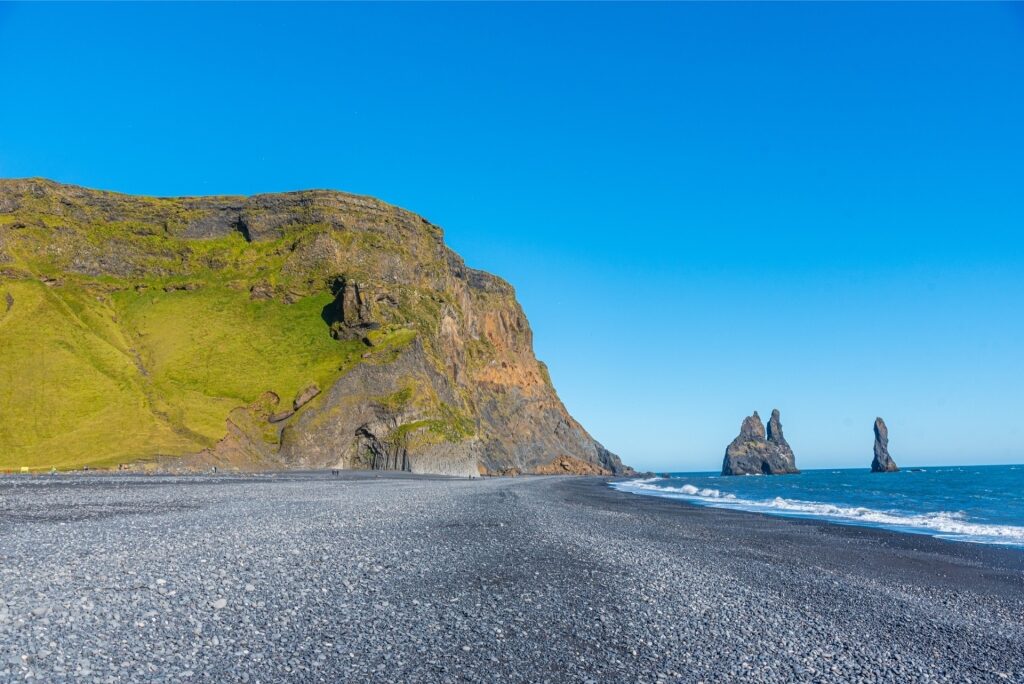
Reynisfjara Beach, Iceland
Relative to the world’s beaches, black sand beaches are rare because they need a very specific set of geological conditions to be created.
Most are located on volcanic islands or along volcanic coastlines with a high concentration of heavy minerals. You will find black sand beaches in Hawaii, Iceland, the Canary Islands, Sicily, and parts of New Zealand. Outside of these areas, they are more unusual.
Can you bring black sand home as a souvenir?
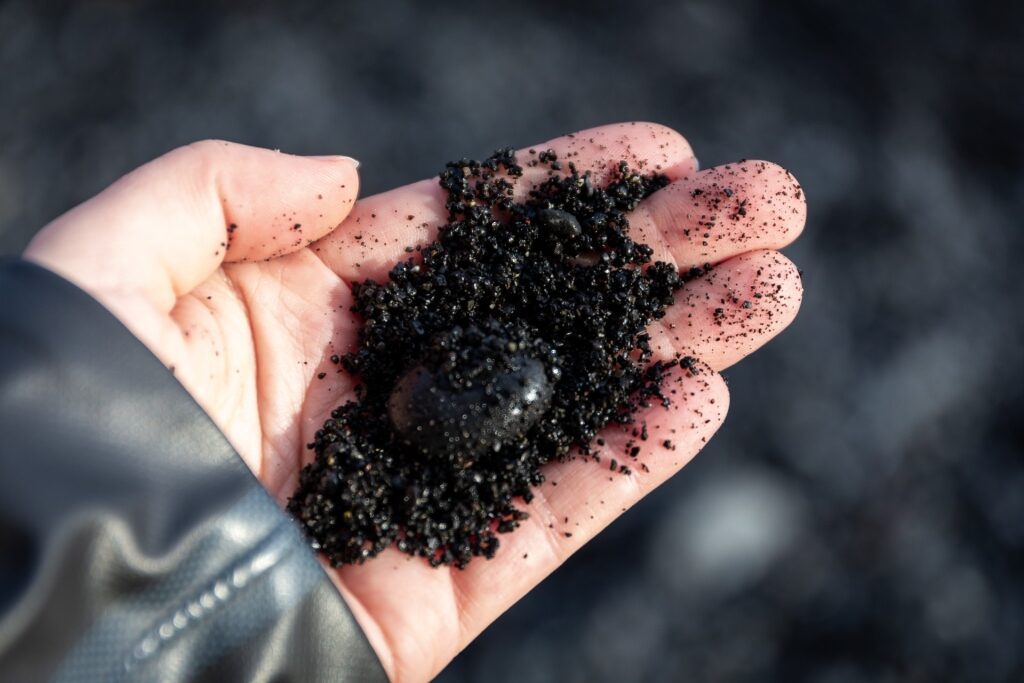
Black sand
In most cases, no. It is generally illegal to remove sand or rocks from beaches at many tourist destinations. These laws are to protect fragile coastlines and cultural resources. Collecting black sand or rocks can result in fines, confiscation by airport authorities, and probably some serious finger-wagging by officials.
Check local regulations before removing any sand or rocks from a beach, or consider buying a beach souvenir from a local shop instead.
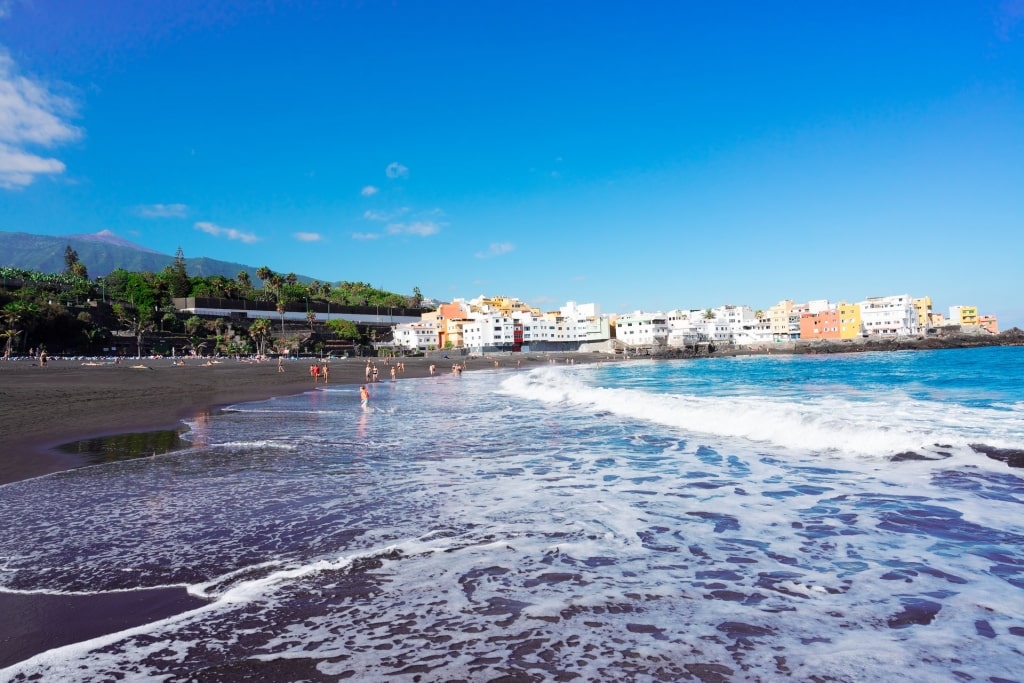
Playa Jardin in Tenerife, Canary Islands
Ready to seek out some of the most dazzling beaches in the world? Browse our itineraries and plan your next cruise.